Human voyage to posthuman: ‘end’/end of the humans?
-Saji Mathew Kanayankal
The emergence of new techno-sciences, especially the advent of bio-nanotechnology, Information Technology (IT) and Artificial Intelligence (AI) launch the era of a techno-culture, in which machines and artefacts take a major function in the life/existence of humanity. As an emerging expertise, nanotechnology is still on the process of development and it is changing. We observe a lot of ideas, imaginations, fictions; yet some realistic movements as a part of its development. In fact, most of our knowledge about it is speculative, but there are a few latest new ‘realistic’ achievements. With the groundbreaking experiments of Prof. Kevin Warwick, who infringed the barrier between human and machine, the discussions on the application of nanotechnology for human enhancement have entered into a new phase.
Apart from its use in purely technological level, nanotechnologies application in therapy, human enhancement and alteration, promises as well as challenges the humanity. Nanotechnology, which promises but endangers the entire human community, is seen as revolution as well as a danger. On the one hand, it opens enormous benefits to humanity with an increased productivity and creativity, openings and longevity, stronger bodies and minds, and a happier, better and ‘enhanced’ life. However, on the other hand, it challenges with risks, even with the possibilities of deteriorating and degenerating human ingenuity. The emergence of new life forms will not be mere nightmare or fiction. At least a few awaits the arrival of the ‘posthumans’ who will broaden the line of immortality. So to compact and integrate the Christian anthropology with the change and technological advancement is a real challenge today. Thus, we pose certain ethical questions:
1. Who is a human being? Shall we stick on to the age old concepts or should we opt for the new advancements? Homo sapiens/Techno sapiens? What would be the moral status of such a ‘technologically advanced device’?
2. Is it ethically permissible to change the fundamental human nature? If it is for the welfare and benefit of one, why don’t we do it? What is fundamental human nature?
3 The question on human autonomy. (Humans should overcome their own limitations with their intellect, reason and skill. They have to overcome their own evolutionary fates by themselves). The questions: Should humans use their technology to become something other than human? What should be the hermeneutical key to measure the human enhancement?
Clarification of Some Terminologies:
(i) Nanotechnology: “the principle of atom manipulation atom by atom, through control of the structure of matter at molecular level. It entails the ability to build molecular systems with atom–by–atom precision, yielding a variety of nanomachines” (Drexler, The Engines of Creation: The Coming of Nanotechnology). This term can be applied to any technique that works and can be understood in a nanometer level (109 metres). According to the strategy, the effectively human-built nanomachine will be no bigger than a bacterium and probably as small as a virus. It could even be virus. The most important offshoot of nanotechnology is its possibility to manufacture things at a low cost and with no pollution.
(ii) Difference between Therapy/Nano-treatment, Enhancement and Alteration.
(a) Therapy: the prevention or cure of disease, or as the restoration or approximation of return to normal physiological function.
(b) Enhancement: the alteration of individual (or group) characteristics, traits, and abilities (both health- and non-health-related) beyond a measurable baseline of normal function.
(c) Alteration: Altering neurobiological functions. This level is the most controversial since the goal is to transcend biological boundaries through technological means to alter human capacities.
Some Important Notes:
1. The First Transhumanist Declaration: (1999) “Humanity will be radically changed by technology in the future. We foresee the feasibility of redesigning the human condition, including such parameters as the inevitability of aging, limitations on human and artificial intellects, unchosen psychology, suffering, and our confinement to the planet earth.” Available at http://www.transhumanism.org/index.php/WTA/declaration/
2. Experience of the First Cyborg:
Kevin Warwick has taken the first steps on this path, using himself as a guinea pig test subject receiving, by surgical operation, technological implants connected to his central nervous system. “In the years ahead we will witness machines with an intelligence more powerful than that of humans. This will mean that robots, not humans, make all the important decisions. It will be a robot dominated world with dire consequences for humankind.” From http://www.kevinwarwick.com/ICyborg.htm
Suggestive Readings:
Jotterand, Fabrice. “Beyond Therapy and Enhancement: The Alteration of Human Nature.” NanoEthics 2 (2008):15–23.
Lustig, Andre. “Enhancement Technologies and the Person: Christian Perspectives.” Religions and Cultures of East and West: Perspectives on Bioethics, Spring (2008): 41-50.
Lin, Patrick and Fritz Allhoff. “Untangling the Debate: The Ethics of Human Enhancement.”
Nanoethics no 2 (2008) 251–264.
Warwick, Kevin. “The Promise and Threat of Modern Cybernetics,” Southern Medical Journal 100, no 1 (2007): 112-115.
Keenan, James F. “Perfecting Ourselves: On Christian Tradition and Enhancement.” Southern Medical Journal 100, no 1 (2007): 96 -97.
Tuesday, October 20, 2009

Friday, June 26, 2009
Hearty Congrats to Fr. Dr. Augustine Kallely
 Fr. Dr. Augustine defending his dissertation
Hearty Congrats to Fr. Dr. Augustine Kallely
LIFT (Leuven-Indian Forum for Theology) heartily congratulates our dear Fr. Dr. Augustine Kallely, who has successfully defended his doctoral dissertation titled “Growing Together: Towards an Integral View of Marital Love in the Kerala Context of Assisted Marriage” on 24th June 2009 at the Catholic University of Leuven. The doctoral defence session was chaired by Prof. Dr. Johan De Travernier of the department of Theological Ethics of our faculty. While Prof. Dr. Joseph Selling was his promoter, Prof. Dr. Roger Burggraeve, Prof. Dr. Thomas Knieps and Prof. Dr. Frank Vosmann comprised the board of examiners.
 Dr. Kellely with the jury: Prof. Dr. Johan De Travernier, Prof. Dr. Frank Vosmann, Prof. Dr. Joseph Selling, Fr. Dr. Augustine Kallely, Prof. Dr. Roger Burggraeve, Prof. Dr. Thomas Knieps
Fr. Dr. Kallely belongs to the archdiocese of Ernakulam-Angamaly in Kerala. He came to Leuven in 2003 to do his Masters in theology, and has continued with his doctoral studies. While we thank Fr. Dr. Augustine Kallely for his fraternal companionship with us for the last six years in Leuven, we wish him an enriching and fruitful ministry in India.
LIFT particularly thanks Dr. Augustine for his active and encouraging participation in LIFT sessions during his stay here. Dank u wel!
Hearty Congrats dear Dr. Kallely, and many best wishes and prayers.
- Joji (for LIFT)
LIFT particularly thanks Dr. Augustine for his active and encouraging participation in LIFT sessions during his stay here. Dank u wel!
Hearty Congrats dear Dr. Kallely, and many best wishes and prayers.
- Joji (for LIFT)
Monday, June 22, 2009
Hearty Congrats to Fr. Dr. George Panna
 Fr. Dr. George Panna defending his dissertation
Hearty Congrats to Fr. Dr. George Panna
LIFT (Leuven-Indian Forum for Theology) joyfully congratulates our dear Fr. Dr. George Panna, who has successfully defended his doctoral dissertation titled, "A LOCAL THEOLOGICAL READING OF THE BIBLICAL MODEL FOR THE INTEGRAL LIBERATION OF THE MARGINALS IN BIJHAN (NORTH-INDIA)", on 18 June 2009, at the Catholic University of Leuven (KUL). The defence session was chaired by the Vice-Dean of the Faculty of Theology, Prof. Dr. Reimund Bieringer. While Prof. Dr. Kristiaan Depoortere was his promoter, Prof. Dr. Marc Steen, Prof. Dr. Hans Ausloos and Prof. Dr. Marianne Moyaert were his correctors.
 Fr. Dr. Geroge Panna with his board of correctors: Prof. Dr. Marianne Moyaert, Prof. Dr. Marc Steen, Fr. Dr. George Panna, Prof. Dr. Kristiaan Depoortere, Prof. Dr. Hans Ausloos, and Prof. Dr. Reimund Bieringer, the Vice-Dean and chair of the defence session
Fr. Dr. George Panna belongs to the archdiocese of Patna in Bihar. He holds his bachelor degrees in philosophy and theology from St. Francis de Sales College and St. Charles Seminary in Nagpur. He came to Leuven for the Masters programme in 2003, and has continued with his doctoral studies.
While we thank Fr. Dr. George Panna for his life with us in Leuven for the last six years, we wish him all God's blessings for his future endeavours, academic and ministerial.
Hearty Congrats dear Dr. George, and many best wishes!
- Joji (for LIFT)
Saturday, June 20, 2009
LIFT-II: 1 June 2009
 Martin Kallungal presents a paper at LIFT-II
LIFT – II: Monday, 01 June 2009
The second session of LIFT was held on Monday, 01 June 2009, between 19 and 21 hrs in Louis Jaansen’s Hall, Holy Spirit College. Eleven doctoral scholars were present for the discussion on George Soares- Prabhu led by Martin Sebastian Kallungal. Martin’s enlightening presentation summarised his theological reflection and evaluation of Soares-Prabhu’s hermeneutical method in the context of India. His paper could be accessed on this blog.

Helen Dantis moderated effectively the theologically productive discussion that followed. Participants focussed on the larger social thrust in Soares-Prabhu’s literature and his approach to interpreting Bible in India, identity-politics, inculturation, the indispensable ecclesiological setting for biblical hermeneutics, the reality of poverty and plurality (in every aspect) in the supposedly one-indian reality etc. Cofee/chai that were made available energised and also tempered the heated but healthy exchanges.

It was agreed to draft a common letter requesting the concerned publishers for information to build up the proposed Indian journals’ theological database. The letter to each journal would be sent by the concerned person/s dealing with particular journal/s. The deadline for submissions to ITJD database remains as fixed earlier – 15th July 2009. The next session, LIFT – III is tentatively fixed for Thursday, 22 October 2009.
-Bosco (for LIFT)
Monday, June 1, 2009
Martin's Paper for LIFT-2, 1 June 2009
Topic
Interpreting the Bible in India: An Appraisal of George M. Soares-Prabhu’s Cross-Scriptural Hermeneutical Method
Introduction
Ø An Indian interpretation of the Bible, in Soares-Prabhu’s view, “results from the cross fertilization of modern methods of New Testament exegesis with contributions from Indian exegetical tradition, coming to flower in the stormy climate of the socio-cultural reality of India Today.” Though he rightly admitted that an exact shape of an exegetical practice cannot be determined a priori and thus abstained from formatting one method applicable to the whole of India, he did predict the directions an Indian exegesis might follow, and materialized those predictions in some of his own interpretations of biblical texts.
Ø Although his was an unfinished project, he did nevertheless try to bring out the viability of a certain critical-integral hermeneutical method which involves at least three moments: a comprehensive grasp of the profound religious meaning of the text; a precise understanding of the specific imperative of the text in a context; and, an awakening into the deeper meanings the text unfolds in a process of comparison with other religious texts available in the context.
Ø The third moment is obviously an inter-religious engagement. And, as matter of fact, all the three constitutive aspects of the interpretive act Soares-Prabhu designs are sensitive to the multi-religious realities. He achieves his inter-religious hermeneutical project by integrating many different social and cognitive concerns of an Indian interpreter – all of which are directly related to the religions in India – into the essential dynamic of interpretation.
Ø Soares-Prabhu’s idea of biblical interpretation as an inter-religious conversational enterprise is what interests us. We will, first of all, briefly expose the kind of cross-cultural hermeneutics developed by/along with his context-sensitive interpretations of the Bible and the meta-reflections thereof; and, to this we will add, in a second place, a Christian theological and a Hindu philosophical critique.
Part I - An Outline
Soares-Prabhu’s Indian Christian Hermeneutics
- a. Semantic Autonomy of Text and the Conversational Character of Understanding
b. Identity of the Interpreter and the Circular Nature of Interpretation
c. A Cross-cultural Hermeneutics of Integration
i. Text, Context, and Co-Texts
ii. Locus Hermeneuticus and the Criteria for Validation
iii. The Actual Process of Integral Interpretation
1. Religious Reading
2. Social Reading
3. Integral Reading
i. Exegetical Suspicion
ii. Concerns of the Indian Interpreter of the Bible
1. The Poor
2. The Indian Way of Thinking
1. The Logic of Inclusion
2. Cosmo-centric Approach
3. Indic Means of Knowledge/ Experience
4. Pragmatic Interests
Part II: Some Questions and Remarks
In this section, we will make a critical reconsideration of some fundamental theological issues at stake in his project. However appreciative one is (as I am) of his proposal for integral reading, one cannot ignore the problematic nature of his idea of ‘religious reading’ which functions as one of the two starting points of interpreting the Bible in India. A half of the religious reading has to be done with direct reference to the Indian religious traditions, especially, Hinduism, while the other half is made in reference to Christianity. He takes Hinduism so seriously because Hindus make up approximately 83% of India’s population, and, more importantly, the traditional Hinduism has shaped ‘the Indian worldview’ shared by different cultural forms.
According to some Hindu scholars, the word religion and categorization of Indians as adherents of different religions distort the indigenous religious phenomenon in India. This is because; unlike in the case of Western Christianity, multiple affiliations are constitutive of Indians, at least the Hindus; also, the separation between culture and religion is unimaginable in the Indian context.
Ø Has Soares-Prabhu, as a Christian interpreter, succeeded in identifying the ‘religious other’ in the Indian context?
Ø Can Indian religious realities be used as raw materials for constructing the Christian theological artefact?
Is there a possibility of charging some abstract biblical images with some Hindu faith-concepts?
Ø Is not Hinduism ‘scapegoated’ in Soares-Prabhu’s biblical interpretations? Some subtle ‘mimetic rivalry’, one may suspect, works behind his engagement with the Indian religions!
The crucial question Soares-Prabhu has to answer in his inter-religious theology is about the notion of authority. He, however, takes for granted that the ‘Jesus of faith’ (as he understands Him,) has authority over all else engaged in dialogue. Thus, Christology becomes the crucial element in Indian theology, though he gives an impression that ecclesiology is of prime importance.
Martin Sebastian Kallungal
Sunday, May 31, 2009
Hearty Congrats to Sr. Dr. Merline

Sr. Dr. Merline defending her doctoral dissertation
LIFT (Leuven-Indian Forum for Theology) heartily congratulates Sr. Dr. Merline Areeparambil, SH, on the successful defence of her doctoral dissertation titled "A Relevant Theology of Women Empowerment in the Contemporary Catholic Church and Society in India with Special Reference to Mulieris Dignitatem" on 28th May, 2009, at the Catholic University of Leuven. She is thus granted by the University the Doctor's degrees in Theology (Ph.D. and S.T.D.). While Prof. Dr. Lambert Leijssen was her promoter, Prof. Dr. Veerle Draulans, Prof. Dr. Thomas Knieps, and Prof. Dr. Annemie Dillen were her examiners.

Sr. Dr. Merline with the board of examiners: Prof. Dr. Thomas Knieps, Prof. Dr. Annemie Dillen, Prof. Dr. Lieven Boeve (Dean of the Faculty of Theology, KUL), Sr. Dr. Merline, Prof. Dr. Lambert Leijssen, and Prof. Dr. Veerle Draulans
Sr. Merline is a member of the religious congregation of the Sisters of the Sacred Heart (S.H.). She holds a Master's Degree in Theology (STL) from St. Peter's Pontifical Institute, Bangalore, India, and a Master of Advanced Studies in Theology and Religion from Katholieke Universiteit Leuven, Belgium. She came to Belgium in 2004 for her pre-doctoral studies, and continued with her doctoral studies.
While we cherish the wonderful time the members of LIFT had with Sr. Dr. Merline during the last 5 years here at KUL, we wish her God's many blessings for her future work in India. God go with you dear Sr. Dr. Merline!
Saturday, May 30, 2009
LIFT-1 Meeting on 30 April 2009
 Augustine Kallely presents a paper at LIFT-1
LIFT - 1: Meeting on 30 April 2009
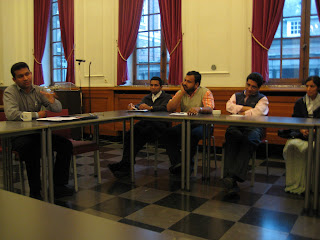
 Date: Thursday, 30th April 2009 Time: 20 to 22 hrs
Venue: Louis-Janssens Hall, Holy Spirit College, Naamsestraat 40, Leuven
In attendance: 20
The first meeting of the Leuven Forum for Indian Theological reflection began a little after 8pm with Joji welcoming everyone and explaining the proceedings. Accordingly, the topic was to be introduced and  explained in 30 minutes, followed by discussion in the group for an hour. Coffee and tea were available for the participants throughout the session.
Augustine Kallely presented his research findings in a paper titled "Growth-Centred Approach to Marital Love". The text could be accessed on this blog. His presentation led to a lively discussion involving socio-cultural and theological implications of his proposals especially in/for the Indian context(s).
Later, Sahayadas, Martin and Simplicio outlined the modalities concerning the proposed database [ITJD] on Indian theological articles/essays leading to an agreem ent on sharing of responsibilities. A summary of the discussion and the allotment of work could be seen at this blog.
A constructive suggestion regarding the time for LIFT forums was accepted unanimously and henceforth the forum would gather from 19 to 21hrs on the date decided upon. Accordingly, LIFT - 2 would be held on Monday, 01st June 2009, from 19 to 21 hrs at Louis Janssens Hall with Martin Sebastian agreeing to initiate and moderate a theological conversation on George Soares-Prabhu.
Bosco (for LIFT)
Subscribe to:
Posts (Atom)